
Remote Onboarding Gear: Chain-of-Custody Done Right
Practical chain-of-custody controls for remote onboarding gear—serial assignment, condition logs, verified handoffs, swaps, and returns—without slowing time-to-equip.
Why remote onboarding breaks accountability (and how to fix it without slowing down)

Remote onboarding is supposed to be fast—but the moment laptops and monitors ship to home addresses, accountability often gets fuzzy. Purchase orders, ad-hoc shipping labels, and spreadsheets can’t reliably answer basic asset-management questions: Who has device X right now? What condition was it in at handoff? What changed during the term? For it-operations and procurement, that uncertainty becomes cost: lost devices, “mystery damage,” and time-consuming reconciliation when employees move, swap roles, or exit.
The fix isn’t more friction; it’s tighter chain-of-custody built into the device-lifecycle from day one. Start with serialized devices (not “a laptop”), then attach every movement—delivery, swap, extension, and return—to a traceable event with proof and timestamps. When you standardize onboarding kits (laptop + dock + monitor + router) and track each component at the asset level, you gain audit-ready visibility while still meeting the business demand: minimal time-to-equip for distributed teams.
Done well, chain-of-custody becomes a risk-management feature that protects cash, reduces disputes, and keeps remote-work velocity high.
The four controls that make chain-of-custody audit-ready (serials, condition, verification, exceptions)
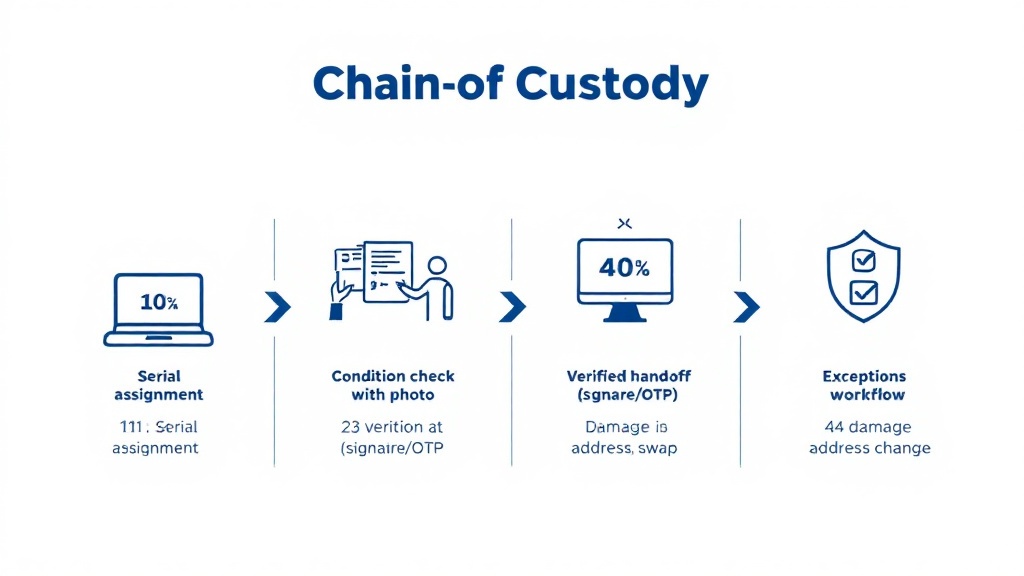
A reliable remote-work chain-of-custody rests on four practical controls. First, serial-level assignment: each laptop, monitor, dock, and router is mapped to a person, address, and term—so reporting and recovery aren’t guesswork. Second, condition logging at every transition (ship, receipt, swap, return). Use standardized checklists (screen, ports, casing, accessories) plus photo capture to minimize “he said / she said” at offboarding.
Third, handoff verification: confirm receipt with a signature, OTP, or identity-backed acknowledgment that ties the person to the asset and condition at that moment. This is where many asset-management programs fail—delivery proof alone doesn’t confirm custody. Fourth, exception handling for real life: missed deliveries, address changes, damaged-in-transit claims, and partial returns. Define a clear workflow for holds, replacements, and escalations, with SLAs and automated reminders so it-operations doesn’t become a human ticket-routing system.
Together, these controls create an end-to-end device-lifecycle record that stands up to audits and reduces risk-management overhead—without adding unnecessary steps for the employee.
Swaps and returns without chaos: keep time-to-equip high and risk low

Swaps and returns are where remote onboarding programs either mature—or unravel. The key is to treat changes as first-class events in the asset-management system. When a monitor fails mid-term, a swap should create a linked record: the replacement asset’s serial, the outgoing asset’s condition, the shipping legs, and the updated kit composition. That preserves a continuous device-lifecycle narrative even as the physical gear changes.
For end-of-term returns, pre-schedule pickups with logistics partners, generate trackable labels, and require return condition confirmation at intake. If a kit comes back missing a dock or with screen damage, the evidence is already attached to the custody record (who had it, when it was last verified, what condition was acknowledged). This reduces disputes and speeds resolution—core risk-management outcomes.
Finally, keep the employee experience simple: clear instructions, one link to confirm receipt, and automated reminders as the term ends. When it-operations can see every asset’s status in real time, remote-work teams stay equipped, finance keeps cash predictable, and onboarding remains fast—even at scale.